How Does MQTT Work With a Smart Control Panel?
With the rapid development of IoT technology, smart control panels have become an important interface for managing connected devices in homes, hotels, offices, and commercial buildings. A modern smart control panel is no longer just a touchscreen switch — it acts as a centralized control terminal that communicates with multiple smart devices and automation systems.
To achieve reliable communication between devices, many smart automation solutions use MQTT (Message Queuing Telemetry Transport), a lightweight messaging protocol widely adopted in IoT applications.
By integrating MQTT, a smart control panel can exchange real-time data with smart devices, gateways, and cloud platforms, enabling flexible and scalable automation solutions.
What Is MQTT in Smart Control Panel Systems?
MQTT is a lightweight IoT communication protocol based on a publish-subscribe architecture.
Unlike traditional device-to-device communication, MQTT uses an intermediate server called an MQTT Broker to manage data transmission between devices.
In a smart control system, the structure usually works like this:
Smart Control Panel → MQTT Broker → Smart Devices
The smart control panel acts as an MQTT client, sending control commands and receiving device status updates through the broker.
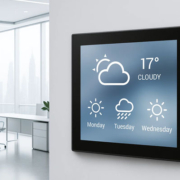
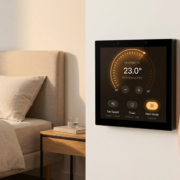
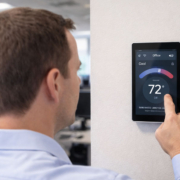
For example, when a user adjusts the room temperature on a touchscreen panel, the panel sends an MQTT message to the HVAC system. After the HVAC system completes the adjustment, it sends feedback back to the panel, updating the display in real time.
MQTT Communication Mechanisms in Smart Control Panel Systems
A smart control panel employing MQTT technology typically executes two primary operational functions:
Transmission of Control Directives
When end users engage with the touchscreen interface, the panel translates the user action into MQTT messages.
Typical examples include:
- Activation or deactivation of lighting systems
- Modification of air conditioning temperature settings
- Manipulation of curtain mechanisms
- Initiation of integrated smart scenes
The directive is transmitted to a designated MQTT topic, whereupon the associated device obtains the instruction via the MQTT broker infrastructure.
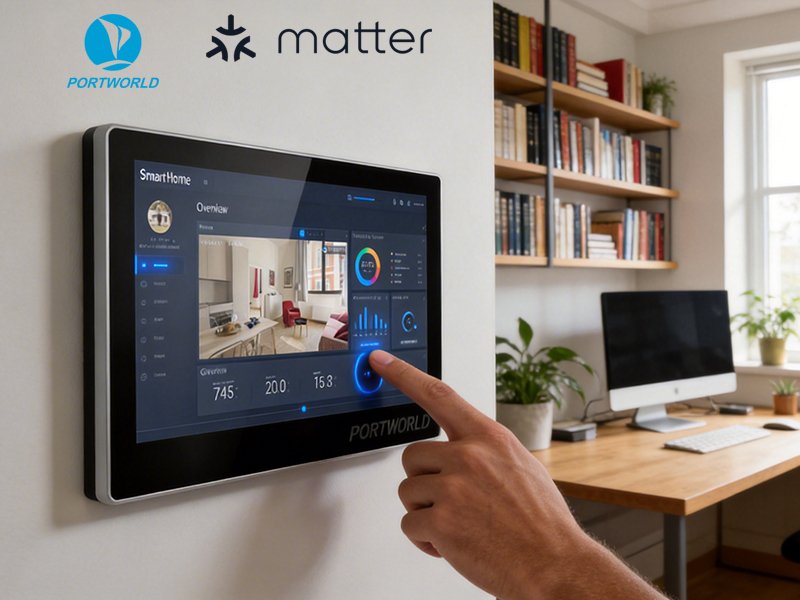
smart home control panel
Illustrative Example:
A user designates “Living Room Light ON” through the control panel interface.
The panel transmits the following:
Topic:
home/livingroom/light/control
Message:
ON
The lighting control device processes the message and implements the requested action.
Obtaining Device Status Feedback
MQTT facilitates bidirectional communication.
Intelligent devices can transmit information to the control panel, encompassing:
- Temperature measurements
- Humidity readings
- Device operational statusPower utilization
- Security notifications
This functionality permits users to supervise their complete smart environment via a single touchscreen interface.
Illustrative example:
The temperature sensor identifies 25°C and transmits the data via MQTT. The intelligent control panel acquires the information and exhibits the existing room temperature.
Why MQTT Proves Advantageous for Smart Control Panels?
Compact and Economical Data Exchange
A principal benefit of MQTT is its minimal bandwidth consumption.
In contrast to conventional communication approaches, MQTT consumes limited network capacity, rendering it appropriate for:
- Internet of Things apparatus
- Intelligent sensing devices
- Integrated control systems
This proves particularly advantageous in smart residential settings where numerous devices must exchange information concurrently.
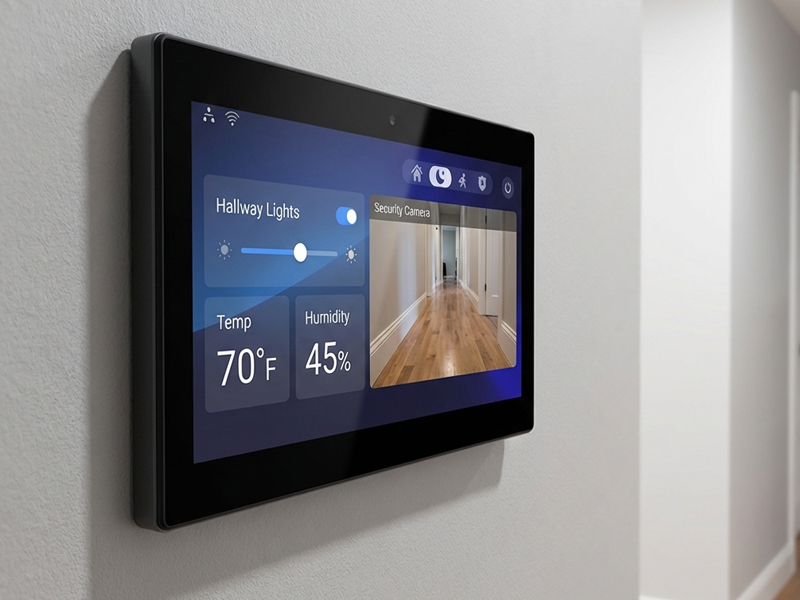
smart home control panel-1
Immediate Device Management
Smart automation necessitates expedited responsiveness.
MQTT facilitates rapid information distribution among:
- Display interfaces
- Network intermediaries
- Management systems
- Detection instruments
Users can regulate devices instantaneously through a touchscreen interface without demanding intricate manual setup procedures.
Flexible Device Integration
A smart control panel can leverage MQTT to establish connections with diverse device types manufactured by various vendors.
Examples include:
- WiFi-enabled smart lighting fixtures
- Zigbee gateway devices
- HVAC control systems
- Energy consumption monitoring solutions
- Security and surveillance devices
MQTT functions as a unified communication protocol across heterogeneous systems.
MQTT Applications in Smart Home Automation
Within smart home environments, MQTT facilitates centralized management of multiple interconnected devices.
Smart Lighting Control
Users possess the capability to regulate:
- Light activation and deactivation
- Brightness intensity levels
- Color temperature settings
- Predefined lighting configurations
The touchscreen interface transmits MQTT directives to illumination control modules, delivering an accessible and user-friendly operational experience.
HVAC and Climate Control
MQTT can integrate smart control panels with:
- Air conditioning units
- Temperature regulation devices
- Mechanical ventilation equipment
Users can observe and modify ambient temperature parameters directly through the wall-integrated touchscreen interface.
Smart Curtain Automation
Motorized window coverings can process MQTT instructions transmitted from the control panel.
Users can establish automated operational modes including:
- Morning activation sequence
- Entertainment viewing configuration
- Resource conservation protocol
Security System Integration
MQTT facilitates the transmission of security data originating from:
- Door sensors
- Motion detectors
- Smart locks
- Cameras
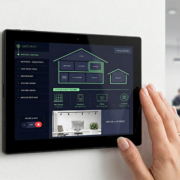
The intelligent panel enables the presentation of current security conditions and real-time alerts.
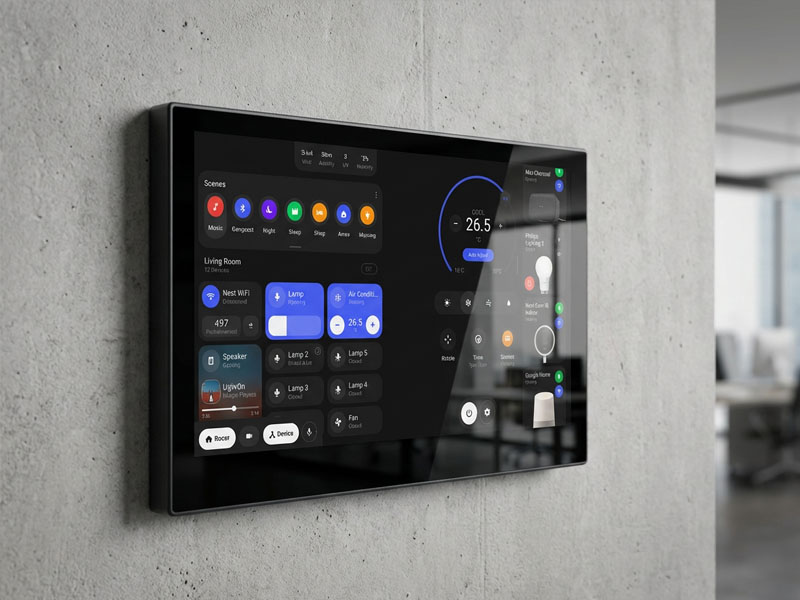
smart home control panel
MQTT Integration Across Diverse Smart Control Panel Platforms
Various hardware platforms can implement MQTT functionality according to specific operational requirements.
ESP32-Based Smart Control Panels
ESP32 implementations are well-suited for resource-constrained IoT deployments.
As an illustration, the Portworld YC-SM43P represents an ESP32-S3 intelligent touch panel engineered for:
- Smart home control
- IoT terminals
- Industrial HMI applications
Primary specifications include:
- ESP32-S3 dual-core processing unit
- 4-inch capacitive touchscreen interface
- WiFi and Bluetooth communication capabilities
- RS485 communication functionality
- LVGL graphical user interface
Through MQTT integration, it functions as a sophisticated IoT control interface.
For sophisticated automation frameworks, Android-powered smart panels deliver enhanced computational performance.
The Portworld YC-SM10P exemplifies this category with:
- RK3566 Quad-Core Cortex-A55 processing architecture
- Android operating system platform
- 10-inch touchscreen display technology
- Ethernet and PoE connectivity options
- RS485 communication support
It facilitates the execution of proprietary Android applications incorporating MQTT communication protocols for:
- Smart home automation systems
- Hotel room management
- Meeting room infrastructure
- Building management solutions
MQTT and Complementary Smart Home Protocols
MQTT is frequently integrated with various other communication technologies.
Examples include:
MQTT + Zigbee
A smart control panel establishes communication with a Zigbee gateway via MQTT, facilitating the management of:
- Intelligent lighting systems
- Sensory devices
- Electrical switches
- MQTT + RS485 Modbus
Within commercial automation environments, MQTT serves to interconnect touchscreen interfaces with Modbus-compliant equipment.
Typical implementations encompass:
- Heating, ventilation, and air conditioning systems
- Power consumption monitoring devices
- Facility management systems
- MQTT + Matter
MQTT functions as a foundational communication infrastructure within comprehensive IoT ecosystems, facilitating seamless data exchange among disparate systems.
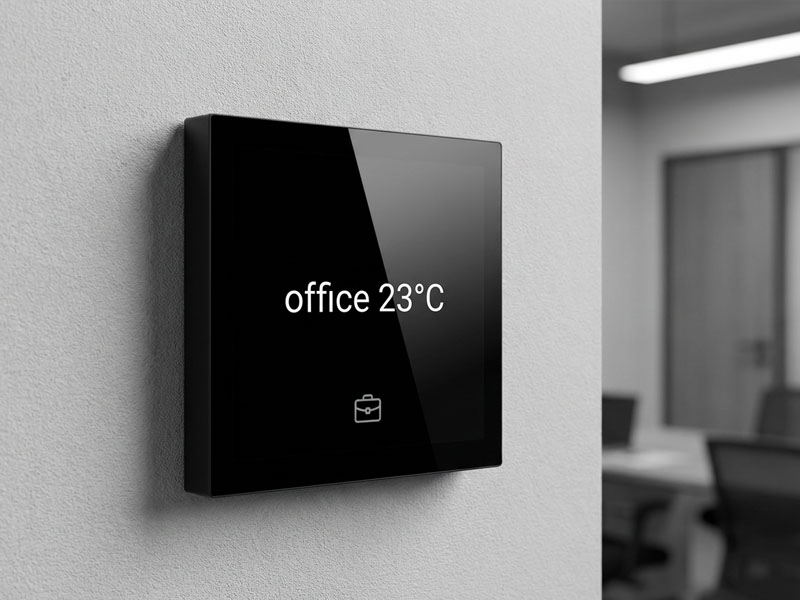
smart touch control panel-2
MQTT Security Considerations for Smart Automation Systems
In enterprise-level deployments, MQTT implementations typically incorporate robust security mechanisms, including:
- Credential verification protocols
- Transport Layer Security encryption
- Permission-based access governance
These protective measures prove essential for:
- Hospitality establishments
- Corporate facilities
- Large-scale automation initiatives
The Evolution of MQTT-Enabled Intelligent Control Interfaces
As intelligent buildings and Internet of Things infrastructure continue to proliferate, control panels are advancing toward greater sophistication and interconnectivity.
MQTT delivers a versatile communication framework that facilitates smart panels in establishing connections with diverse devices and ecosystems.
Equipped with advanced processors including the ESP32-S3 and Rockchip RK3566, contemporary smart control panels can consolidate touchscreen functionality, IoT communication capabilities, and automation orchestration within a single, streamlined form factor.
MQTT constitutes a critical component in contemporary smart control panel architectures by facilitating instantaneous, efficient data exchange among end-users, connected devices, and automation infrastructure.
Through MQTT implementation, smart control panels deliver:
- Unified device administration
- Instantaneous system visibility
- Adaptable IoT interoperability
- Expandable automation frameworks
Across residential properties, hospitality establishments, corporate facilities, and manufacturing environments, MQTT-driven smart control panels establish a dependable infrastructure for developing networked and sophisticated operational systems.