How to Choose a Smart Control Panel for Hospital Rooms?
As healthcare facilities transition towards intelligent environments, smart control panels are increasingly becoming a vital component of contemporary patient rooms. These panels offer centralized management for lighting, HVAC, nurse call systems, curtains, entertainment, and IoT devices, thereby enhancing both patient satisfaction and the efficiency of hospital operations.
Nonetheless, selecting the appropriate smart control panel for hospital settings necessitates thorough evaluation of factors such as reliability, integration capabilities, user experience, and long-term functionality.
1. Select the Appropriate Screen Size and User Interface
The touchscreen serves as the primary means of interaction for both patients and healthcare personnel.
Various applications necessitate different display dimensions:
Ideal for:
- Bedside control
- Basic adjustments for lighting and HVAC
- Nurse call buttons
- Compact wall-mounted setups
Benefits:
- Space-efficient design
- Simple installation
- Reduced power consumption
- 7–10 Inch Smart Control Panel
Ideal for:
- Patient room dashboards
- Hospital information systems
- Video communication
- Advanced room automation
Benefits:
- Larger interface
- Enhanced information display
- Improved accessibility for patients
- 14-Inch and Larger Panels
Ideal for:
- Nurse stations
- Healthcare monitoring terminals
- Advanced building management interfaces
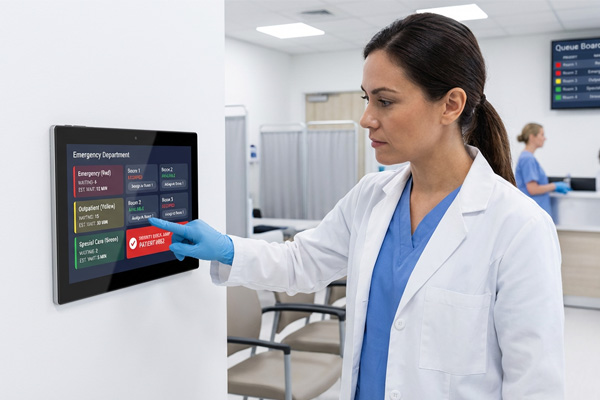
digital signage display for hospital waiting rooms
2. Evaluate Dependable Operating Systems
The operating system plays a crucial role in determining both software adaptability and system reliability.
Benefits:
- Simplified application development
- Compatibility with custom APK applications
- Advanced graphical interfaces
- Multimedia functionality
- Integration with cloud platforms
Ideal for:
- Patient interaction terminals
- Hospital information services
- Smart room dashboards
Benefits:
- Extensive customization options
- Consistent long-term performance
- Enhanced control over embedded systems
- Development of custom drivers
Ideal for:
- Interfaces for medical equipment
- Industrial healthcare systems
- Tailored hospital automation solutions
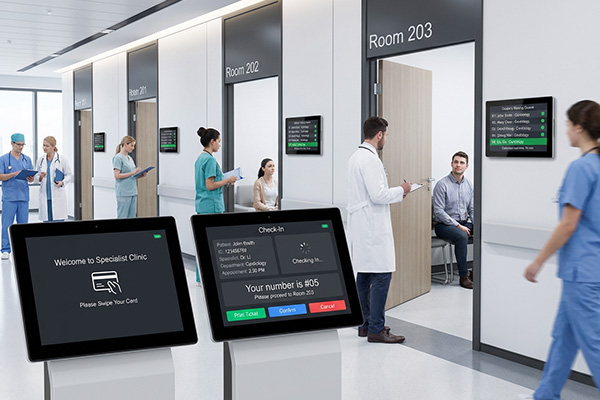
digital signage display for hospital waiting rooms
3. Ensure Robust Communication Capabilities
Hospital rooms typically house various systems that require seamless communication.
An effective smart control panel should provide support for:
Ethernet
Utilized for:
- Hospital networks
- Cloud platforms
- Centralized management systems
Power over Ethernet (PoE)
PoE is strongly advised for use in hospital installations.
Advantages:
- Delivers power and data via a single cable
- Streamlined wiring process
- Simplified maintenance procedures
- Enhanced reliability in deployment
RS485 / Modbus
Ideal for linking:
- HVAC control systems
- Lighting solutions
- Building automation equipment
- WiFi and Bluetooth technologies
Applications include:
- Wireless sensor networks
- Internet of Things (IoT) devices
- Mobile connectivity solutions
4. Verify Integration with Hospital Systems
A hospital smart control panel must not function as a standalone device.
It should facilitate integration with:
- Nurse call systems
- Building Management Systems (BMS)
- HVAC systems
- Lighting control systems
- Access control systems
- Hospital IoT platforms
Common protocols include:
- Modbus
- MQTT
- BACnet
- KNX
- REST API
A versatile communication platform guarantees simpler system expansion in the future.
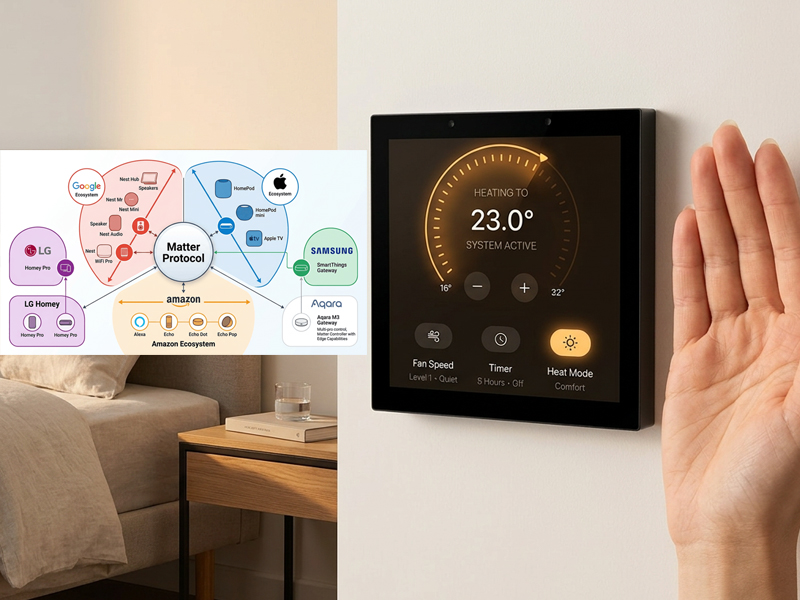
smart home control panel
5. Emphasize Reliability and Long-Term Operation
Hospital equipment necessitates consistent operation around the clock.
Key hardware considerations encompass:
- Industrial-grade components
- Long lifecycle processors
- Fanless design
- Stable power management
- Wide operating temperature range
Recommended hardware includes:
- ARM Cortex-A processors
- 2GB+ RAM
- 16GB+ storage
- Reliable embedded operating systems
Processors like RK3566 and RK3568 are frequently utilized in embedded smart panels due to their performance and reliability.
6. Opt for a Patient-Centric Design
Hospital users encompass patients of various ages and health conditions.
An effective hospital smart control panel should feature:
- Large touch buttons
- User-friendly interface layout
- High-contrast display
- Support for multiple languages
- Surface that is easy to clean
The user interface should enable patients to swiftly access:
- Lighting controls
- Temperature settings
- Nurse assistance
- Room services
7. Prioritize Hygiene and Installation Considerations
Healthcare settings necessitate straightforward maintenance.
Recommended design attributes include:
- Flat front panel
- Surface that is easy to clean
- Wall-mounted installation
- Robust mounting structure
Ensuring compatibility with standard wall boxes is crucial for global implementation:
- UK 86 type
- EU wall boxes
- US wall boxes
8. Assess Customization Options
Each hospital project presents unique requirements.
Select a supplier that offers customization options, such as:
- Software Customization
- Tailored UI design
- Hospital branding
- Application development
- System integration
- Hardware Customization
- Screen dimensions
- Processor selection
- Camera/microphone integration
- Additional sensors
- Custom enclosure
Smart Control Panel Selection Checklist
| Requirement | Recommended Feature |
|---|---|
| Patient room control | 4–10 inch touchscreen |
| Hospital network | Ethernet / PoE |
| HVAC integration | RS485 / Modbus |
| Custom applications | Android/Linux support |
| Long-term operation | Industrial-grade hardware |
| Easy installation | Wall-mounted design |
| System integration | Open communication protocols |
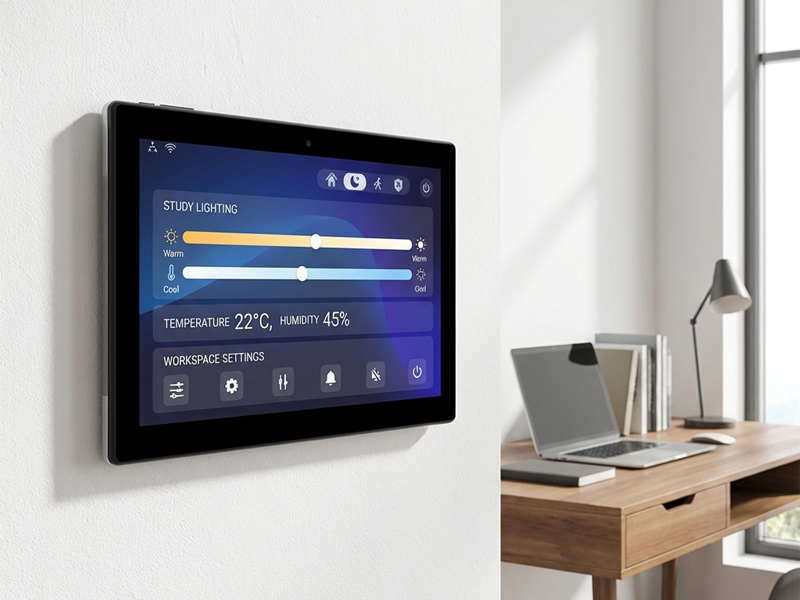
sm55p-smart home control panel
Portworld Smart Control Panel Solutions for Healthcare
Portworld offers tailored smart touch panels specifically designed for healthcare, building automation, and IoT applications.
YC-SM43P ESP32-S3 Smart HMI Panel
Features:
- 4-inch touchscreen
- LVGL graphical interface
- RS485 communication
- Ethernet + PoE support
- Compact wall-mounted design
Ideal for:
- Bedside control
- Smart room interfaces
- Healthcare IoT applications
RK3566/RK3568 Android/Linux Smart Control Panels
Features:
- Android/Linux compatibility
- High-performance ARM processors
- Various screen sizes
- Ethernet, PoE, RS485 connectivity
- Custom software support
Ideal for:
- Hospital room automation
- Patient interaction terminals
- Healthcare management systems