1500 Nits vs. 2500 Nits Outdoor Digital Signage: Which Should You Choose?
When choosing outdoor digital signage, brightness is a key specification to evaluate. A screen that appears sharp in a showroom may be hard to read in daylight, particularly when direct sunlight hits the display.
For many commercial outdoor installations, buyers consider two common brightness levels: 1500 nits and 2500 nits. Both may work outdoors, but each is suited to different lighting conditions and installation settings.
Will 1500 nits meet your project’s needs, or is a 2500-nit display a better investment?
This guide compares these brightness levels and outlines how to select the right outdoor digital signage for retail stores, gas stations, shopping centers, transit areas, and other commercial settings.
1. What Does Nits Mean in Digital Signage?
Nits measure a display’s luminance, or the amount of light it emits toward the viewer. One nit is equal to one candela per square meter (cd/m²).
Put simply, a higher nit rating means a brighter screen.
For reference:
Indoor commercial displays typically operate at around 300–500 nits.
Bright indoor displays or screens facing windows may need greater brightness.
Outdoor digital signage commonly uses 1500–2500 nits or more, depending on exposure to sunlight.
Outdoors, sunlight and reflections compete with the light emitted by the screen. Under intense ambient lighting, a standard indoor display can look washed out, making text, images, and videos hard to view.
Brightness is not the only factor affecting visibility, however. Contrast, anti-glare treatment, cover glass, mounting angle, and the direction of sunlight also shape the viewing experience.
2. 1500-Nit Outdoor Digital Signage: When Is It Sufficient?
A 1500-nit display is a practical choice for outdoor settings with partial shade or limited exposure to direct sunlight.
It may be suitable for locations where a canopy, building structure, or other feature shields the screen.
Common applications include:
Covered shopping areas
Displays installed beneath shopping center canopies or along covered walkways may perform well at 1500 nits when direct sunlight is limited.
Gas station canopies
Digital signage mounted beneath fuel station roofs may not be exposed to direct sunlight throughout the day. A 1500-nit configuration may be appropriate, depending on the screen’s orientation and nearby reflective surfaces.
Outdoor service counters
Restaurants, ticket counters, and other service areas with covered installation locations may not need the highest available brightness level.
Shaded public information displays
Information screens placed beneath shelters or building overhangs can benefit from high brightness without necessarily requiring a 2500-nit configuration.
Advantages of 1500 Nits
Suitable for many outdoor installations in shaded areas.
Depending on the display design, it may reduce the power consumption and heat associated with higher brightness levels.
It may allow for a more cost-effective hardware configuration.
With suitable anti-glare treatment and careful positioning, it can provide adequate visibility.
Potential Limitations
A 1500-nit screen may be difficult to see if direct sunlight falls on its surface for prolonged periods. Visibility may also decline when the display faces reflective surroundings or intense afternoon sunlight.
Therefore, 1500 nits should not be assumed to meet the needs of every outdoor installation.
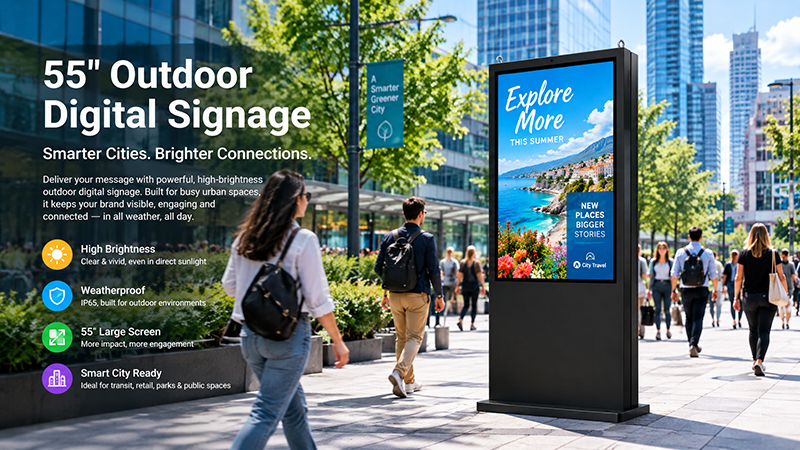
55 inch digital sigange display
3. 2500 Nits Outdoor Digital Signage: When Do You Need It?
A 2500-nit display delivers higher brightness and is generally better suited to outdoor locations with more demanding lighting conditions.
It provides extra brightness headroom when a screen is exposed to strong daylight or occasional direct sunlight.
Common applications include:
Outdoor retail advertising
Storefronts, shopping districts, and commercial entrances are exposed to changing sunlight throughout the day. A 2500-nit display can improve visibility in these environments.
Gas stations and roadside locations
Promotional screens near roads or fuel stations may be placed in open areas with little shade. Higher brightness can help keep their content visible.
Transportation areas
Information displays around parking facilities, bus stops, and outdoor passenger areas may need to remain legible as daylight conditions change.
Shopping centers and public spaces
Outdoor advertising screens in open plazas or at entrances can benefit from the added brightness.
Advantages of 2500 Nits
Greater brightness in environments with strong ambient light.
More installation options where the display receives partial direct sunlight.
Improved potential visibility in exposed locations.
Additional brightness capacity for settings where lighting conditions vary throughout the day.
Potential Limitations
Higher brightness typically requires more backlight power and produces more heat. The enclosure, power supply, and thermal management system must be designed to accommodate actual operating conditions.
A 2500-nit rating does not ensure optimal visibility in all direct-sunlight conditions. For installations exposed to intense sunlight throughout the day, buyers may need to consider displays with higher brightness and an appropriate optical design.
4. 1500 Nits vs. 2500 Nits: Key Differences
The following table summarizes the practical differences.
| Comparison | 1500 Nits | 2500 Nits |
|---|---|---|
| Brightness output | High | Higher |
| Shaded outdoor areas | Suitable | Suitable |
| Partial sunlight | Depends on exposure | Generally more suitable |
| Strong daylight | May have limitations | Better brightness headroom |
| Direct sunlight | May struggle | Still depends on exposure and optical design |
| Power requirements | Model-dependent | Typically higher at maximum brightness |
| Thermal requirements | Requires appropriate cooling | Greater attention to heat dissipation |
| Typical selection | Covered installations | More exposed installations |
The key difference is not simply that 2500 nits is brighter. It is whether the additional brightness is necessary for the actual installation environment.
For a screen installed under a deep canopy, choosing 2500 nits may provide little practical benefit if 1500 nits already delivers clear content.
For a screen exposed to strong daylight, however, the additional brightness can make a meaningful difference.
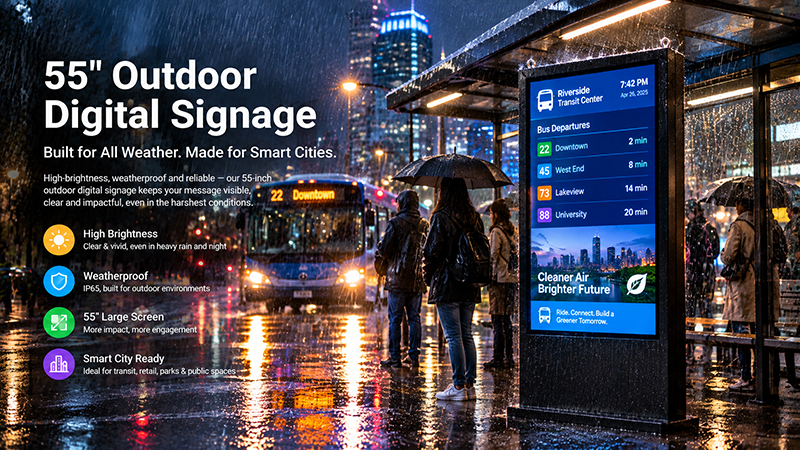
55 inch outdoor digital signage display
5. Brightness Is Only One Part of the Picture: Other Factors That Influence Outdoor Visibility
Even a bright display may perform poorly if other important screen characteristics are ignored.
Before deciding between 1500 and 2500 nits, consider the following factors.
Anti-Glare and Anti-Reflective Treatments
Sunlight reflecting off the screen can lower contrast and make content harder to read.
Anti-glare and anti-reflective treatments help control reflections, but their performance depends on the glass, coating, and overall display design.
For outdoor installations exposed to the elements, ask the supplier about the cover glass and its optical properties instead of comparing brightness figures alone.
Viewing Angle
The display should remain legible from the locations where customers or pedestrians are likely to view it.
Review its horizontal and vertical viewing characteristics, especially if it will be installed above eye level or alongside a road.
Automatic Brightness Adjustment
An ambient light sensor can vary the screen’s brightness in response to surrounding light conditions.
For instance, the display can use higher brightness during the day and dim at night.
This feature can make viewing more comfortable and help control energy use. It is particularly beneficial for outdoor signage that operates from daytime through the evening.
Thermal Management
High-brightness LCD panels produce heat, especially when operated at maximum brightness for long periods.
Outdoor displays require effective heat dissipation and temperature control. Consider the enclosure design, ventilation or cooling system, and supported operating temperature range.
Weather and Physical Protection
A display’s brightness does not indicate whether it can withstand outdoor conditions.
Review the enclosure’s IP rating, screen protection, sealing design, and ability to resist environmental exposure. In public locations, protection against physical impacts may also be necessary.
6. How to Choose the Right Brightness for Different Applications
The following recommendations provide a starting point for commercial projects.
| Application | Suggested brightness to evaluate | Important consideration |
|---|---|---|
| Covered shopping walkway | 1500 nits | Limited direct sunlight |
| Gas station under canopy | 1500–2500 nits | Sun direction and canopy coverage |
| Outdoor retail entrance | 1500–2500 nits | Changing daylight conditions |
| Open shopping plaza | 2500 nits or higher | Direct sunlight exposure |
| Roadside advertising | 2500 nits or higher | Screen orientation and viewing distance |
| Fully exposed outdoor location | Evaluate 2500 nits and higher options | Peak sunlight and reflection |
These are project-planning suggestions, not universal brightness standards. The final specification should be based on an assessment of the installation site.
A useful approach is to check the location at different times of day. Morning sunlight, midday exposure, and afternoon sunlight can affect the screen differently depending on its orientation.
If possible, test a display at the actual installation position before confirming a large-scale deployment.
7. How Brightness Influences Power Use and Operating Costs
Brightness also influences a display’s operating requirements.
When both are running at their maximum rated brightness, a 2500-nit display typically requires more backlight power than a comparable 1500-nit model. This may increase electricity use and heat output.
For commercial projects, buyers should look beyond the initial purchase price.
Key questions include:
- What is the rated power consumption at maximum brightness?
- Does the display offer automatic brightness adjustment?
- What type of cooling system does it use?
- Can brightness be reduced during nighttime hours?
- Is the display built to handle the required daily operating schedule?
Automatic brightness control can prevent the screen from running at full output when ambient light levels are low.
In multi-screen installations, even modest differences in power consumption can influence long-term operating costs.
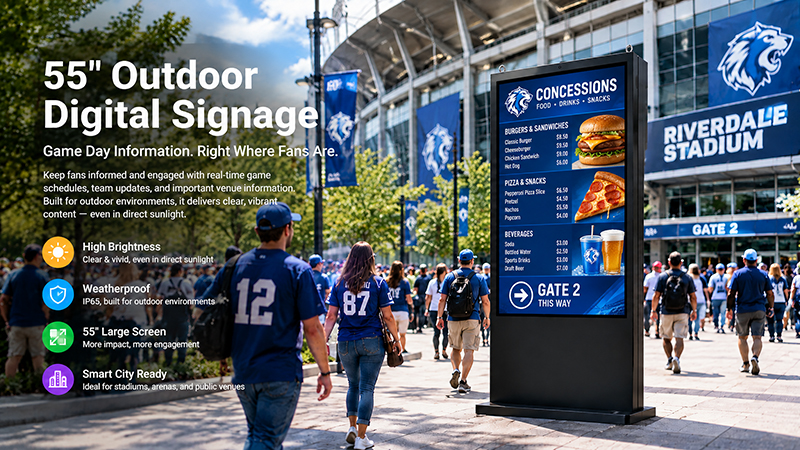
55 inch digital signage display
8. Portworld 55-Inch Outdoor Digital Signage: 1500–2500 Nits
For commercial projects requiring large-format outdoor advertising, Portworld offers a 55-inch digital signage display with configurable brightness levels ranging from 1500 to 2500 nits.
Designed for outdoor commercial use, the display combines high brightness with environmental protection.
Key specifications include:
- Screen Size: 55 inches
- Brightness: 1500–2500 nits, depending on configuration
- Protection Rating: IP65
- Impact Protection: IK10
- Application: Outdoor advertising and public information
Operating Design: Intended to meet the extended operating requirements of commercial use
The 1500-nit configuration may suit covered or partially shaded areas, while the 2500-nit option offers greater brightness for locations with more direct exposure.
IP65-rated protection helps guard the enclosure against dust ingress and water jets under the conditions specified by the rating. IK10 denotes a defined level of impact resistance. Neither rating guarantees protection from salt corrosion, chemical exposure, or all extreme weather conditions.
For installations involving particular operating temperatures, coastal environments, or continuous exposure to full sunlight, consult the supplier to confirm the detailed environmental specifications.
Portworld also offers OEM/ODM services for commercial display projects, including hardware configuration, embedded motherboard solutions, system customization, enclosure design, and branding requirements.
9. Questions to Ask Before Ordering Outdoor Digital Signage
Before choosing a 1500-nit or 2500-nit model, confirm the following with your supplier:
- Is the stated brightness the actual rated display output?
- Is brightness measured at the panel or the finished display surface?
- Does the screen include anti-glare or anti-reflective treatment?
- Is automatic brightness adjustment supported?
- What is the maximum power consumption?
- How does the enclosure manage heat?
- What are the supported operating temperature and humidity ranges?
- What IP and IK ratings apply to the complete assembled unit?
- Is the display designed for the required daily operating hours?
- Can a sample be tested under the actual installation conditions?
These questions help ensure that the selected display matches the project rather than simply offering an attractive specification on paper.