RK3576 vs RK3588 for Linux HMI Panels
In the world of Human-Machine Interface (HMI) panels, the processor is a key component that drives performance, reliability, and overall user experience. When it comes to Linux-based HMI panels, Rockchip offers two standout processors: the RK3576 and the RK3588. Both of these processors provide excellent performance, but understanding their key differences is crucial to selecting the right one for your application.
This article compares the RK3576 and RK3588 processors, exploring their respective strengths and how they impact the performance of Linux-based HMI panels.
Overview of the RK3576 and RK3588 Processors
RK3576 Processor
The RK3576 is a mid-range ARM-based SoC (System on Chip) from Rockchip, designed for industrial and embedded applications. It is particularly well-suited for HMI panels, smart displays, and other IoT devices. The processor is built around ARM Cortex-A55 cores, offering a balance between power efficiency and performance.
Key Features of the RK3576:
- CPU: Quad-core ARM Cortex-A55 up to 1.8GHz.
- GPU: Mali-G57 for efficient graphics processing.
- RAM: Supports up to 8GB of LPDDR4x memory.
- Video Decoding: Supports 4K video decoding at 60Hz.
- I/O Ports: Rich I/O support, including USB, Ethernet, and serial interfaces like RS232/RS485.
- Operating System: Supports Linux-based operating systems, such as Ubuntu and Android.
RK3588 Processor
The RK3588 is the flagship high-performance processor from Rockchip, designed for high-end embedded systems, smart control panels, and digital signage. It delivers significantly more processing power than the RK3576 and is ideal for complex applications that require advanced graphics and AI integration.
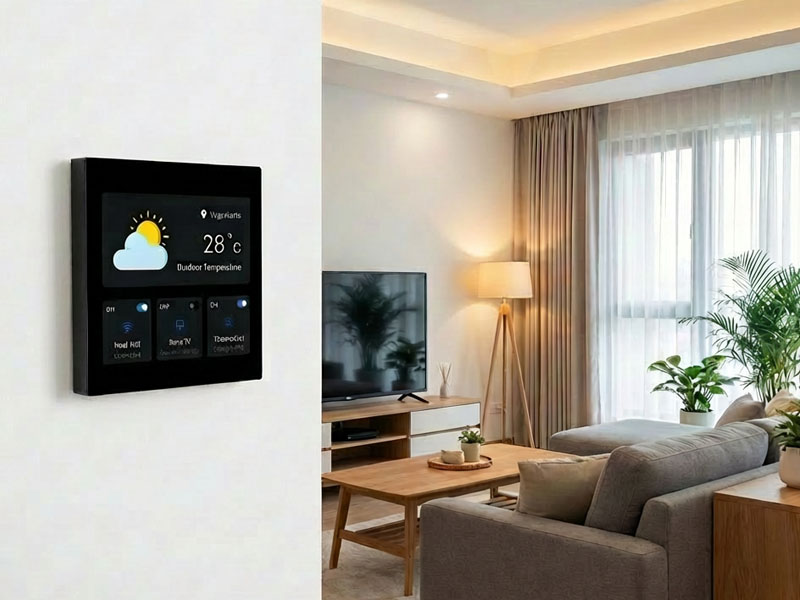
smart home control panel
Key Features of the RK3588:
- CPU: Octa-core configuration, consisting of 4x Cortex-A76 and 4x Cortex-A55 cores, clocked up to 2.6GHz.
- GPU: Mali-G610 MP4 for advanced graphics processing.
- AI Processor: Built-in NPU (Neural Processing Unit) for AI acceleration, supporting 4 TOPS (Tera Operations Per Second).
- RAM: Supports up to 16GB of LPDDR4x or LPDDR5 memory.
- Video Decoding: Supports 8K video decoding at 60Hz and 4K@120Hz.
- I/O Ports: Extensive I/O options including USB 3.0, PCIe 3.0, and HDMI 2.1.
- Operating System: Supports Linux, Android, and other embedded OS.
RK3576 vs RK3588: Key Differences for Linux-Based HMI Panels
1. Performance: Power Efficiency vs. High-End Processing Power
The primary difference between the RK3576 and RK3588 lies in their processing power.
- RK3576 is more power-efficient, featuring quad-core Cortex-A55 processors. It is well-suited for applications that require moderate performance and power efficiency, such as industrial HMI panels, smart displays, and other embedded systems.
- RK3588, on the other hand, boasts an octa-core CPU with high-performance Cortex-A76 cores. This makes it perfect for applications that demand high computational power, such as AI integration, 8K video output, and advanced graphical processing. It’s ideal for high-end HMI panels used in environments like smart homes, digital signage, and advanced automation systems.
In terms of raw performance, RK3588 is the clear winner, offering better overall processing power with its higher clock speeds, additional cores, and AI capabilities.
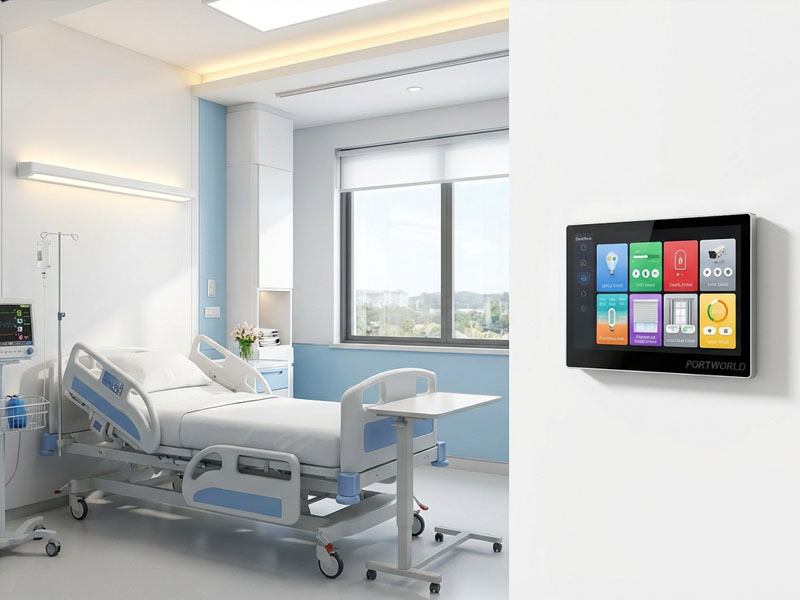
smart touch control panel
2. Graphics and Video Output: 4K vs. 8K
- RK3576 supports 4K video decoding at 60Hz, which is perfect for most industrial applications or commercial HMI panels where high-definition video output is required, but 8K output is unnecessary.
- RK3588 takes it to the next level, with support for 8K video decoding at 60Hz, and the ability to support 4K at 120Hz. This makes the RK3588 ideal for high-end HMI panels that demand ultra-high-definition visuals, such as digital signage, smart home displays, or interactive kiosks.
If your application demands high-resolution video output or real-time video processing, RK3588 is the better choice for its 8K capability.
3. AI and Machine Learning Capabilities
- RK3576 is equipped with basic AI features but does not have the dedicated AI processing capabilities like the RK3588.
- RK3588 shines with its dedicated NPU (Neural Processing Unit), which can accelerate machine learning tasks. This makes it particularly suitable for advanced use cases such as face recognition, voice control, automated systems, and smart home devices.
If your HMI panel needs AI-powered features like facial recognition or smart automation, the RK3588 with its NPU is the optimal choice.
4. RAM and Storage: Scalability for Demanding Applications
- RK3576 supports up to 8GB of RAM, which is ample for most industrial applications requiring moderate data processing and multitasking.
- RK3588 supports up to 16GB of RAM, making it ideal for resource-intensive applications. Whether it’s multi-tasking between numerous apps or processing high-resolution videos, the RK3588 can handle it all, providing scalability for future demands.
5. I/O Ports and Connectivity
Both the RK3576 and RK3588 come with a rich set of I/O ports for device integration, including Ethernet, USB, PCIe, and serial interfaces.
- RK3576 offers essential connectivity features that meet the needs of most industrial environments.
- RK3588 offers more advanced connectivity options, including USB 3.0, PCIe 3.0, HDMI 2.1, and support for faster storage interfaces.
For applications requiring high-speed data transfer, faster peripheral connections, or additional network interfaces, the RK3588 provides more flexibility.
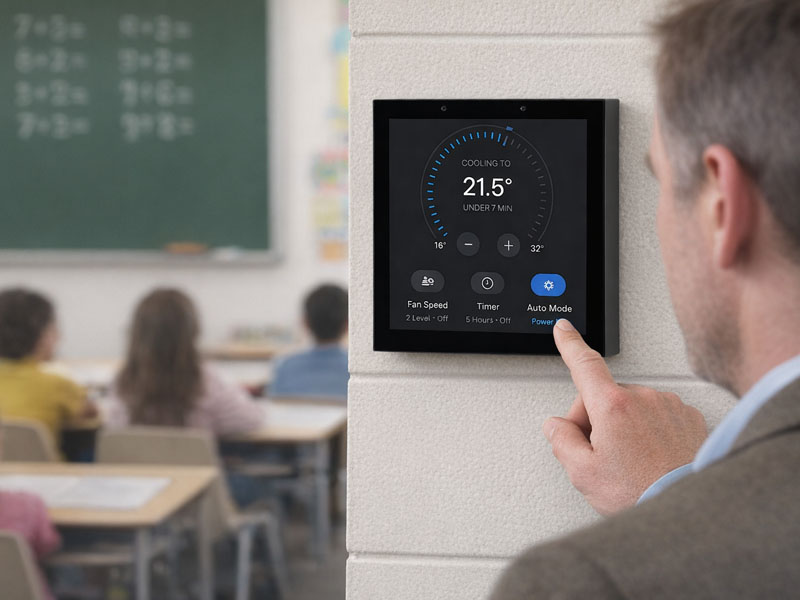
Smart Home Touch Control Panel0-1
Which Processor Should You Choose for Your Linux-Based HMI Panel?
When to Choose RK3576:
- Budget-Friendly Solution: If your application doesn’t require 8K video output, advanced AI processing, or extremely high performance, the RK3576 is an excellent choice for cost-effective solutions.
- Industrial and Commercial Use: The RK3576 is well-suited for industrial HMI panels, smart displays, or point-of-sale systems that focus on basic interactive control without the need for intensive graphical or AI-based tasks.
- Power Efficiency: If your application is constrained by power or heat dissipation, the RK3576 offers a more power-efficient solution while still providing good performance.
When to Choose RK3588:
- High-End, Feature-Rich Applications: If your HMI panel requires 8K video output, advanced AI features, or the ability to handle high-resolution displays and complex tasks, the RK3588 is the ideal processor.
- AI and Machine Learning: If you need AI-powered functionalities like voice recognition, face recognition, or intelligent automation, the RK3588’s NPU will provide unmatched capabilities.
- Scalability: For future-proofing and ensuring your system can handle increasingly demanding applications, the RK3588 provides ample processing power, memory, and storage.
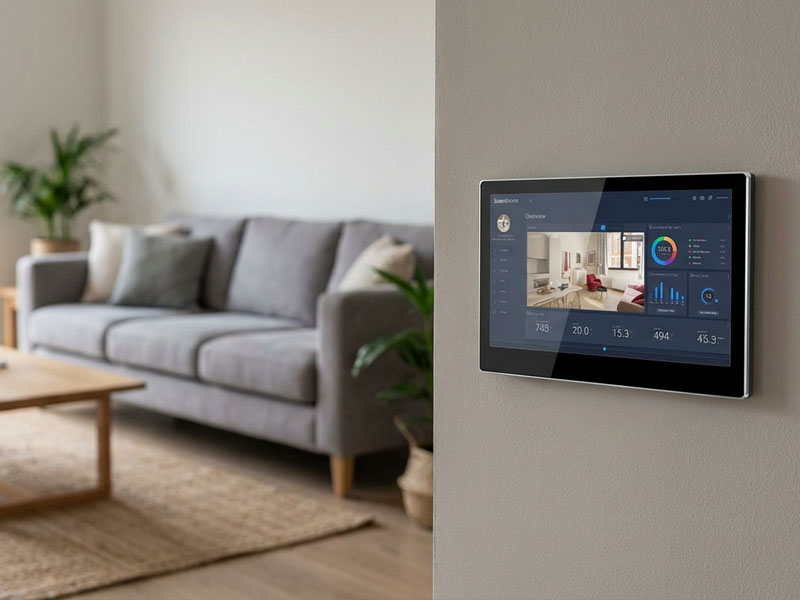
smart home control panel
RK3576 vs. RK3588 – Choosing the Right Processor for Your Linux-Based HMI Panel
Both the RK3576 and RK3588 processors are excellent choices for Linux-based HMI panels, with each catering to different requirements and use cases.
- RK3576 is perfect for budget-conscious projects that don’t require the power of 8K video, extensive AI capabilities, or high-end graphics.
- RK3588 is the go-to solution for high-performance applications that demand AI integration, 8K video output, and superior multitasking capabilities.
By understanding your project’s needs—whether it’s industrial automation, smart home applications, or advanced digital signage—you can choose the processor that best suits your performance and budget requirements.