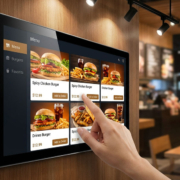
IP65 vs. IP66 Outdoor Advertising Displays: Key Differences
Outdoor advertising displays must cope with varying weather, including rain, dust, high winds, and temperature changes. When businesses install digital signage in exposed areas, enclosure protection is a key consideration in choosing the equipment.
Two widely discussed protection ratings are IP65 and IP66. Both are dust-tight, but they offer different levels of resistance to water jets. Knowing how they differ can help buyers select suitable outdoor advertising displays for shopping centers, gas stations, roadside sites, and other commercial settings.
Will IP65 meet your project’s needs, or is IP66 the better choice?
This guide describes how both ratings work, compares their practical performance, and outlines other factors to consider when purchasing outdoor digital signage.
1. What Do IP65 and IP66 Mean?
IP stands for Ingress Protection. Defined by IEC 60529, the rating system indicates how well an enclosure resists the entry of solid objects and water.
The code consists of two digits:
- First digit – Solid-particle protection: Describes the level of protection against dust and other solid objects.
- Second digit – Water protection: Describes resistance to various types of water exposure.
- Both IP65 and IP66 share the same first digit: 6. Under the specified test conditions, this signifies that both are dust-tight.
The ratings differ in the second digit:
- IP65: Protected against water jets.
- IP66: Protected against powerful water jets.
In practical terms, IP66 is tested under more demanding water-jet conditions than IP65.
2. IP65 vs. IP66: What Is the Technical Difference?
The key distinction between IP65 and IP66 is the force of the water jets used in testing.
Under IEC 60529, each rating is tested with a different nozzle size and water flow rate.
| Test condition | IP65 | IP66 |
|---|---|---|
| Dust protection | Dust-tight | Dust-tight |
| Water protection | Water jets | Powerful water jets |
| Nozzle diameter | 6.3 mm | 12.5 mm |
| Water flow rate | 12.5 L/min | 100 L/min |
| Test distance | 2.5–3 m | 2.5–3 m |
| Test duration | At least 3 minutes | At least 3 minutes |
The flow rates illustrate why IP66 involves a more rigorous water-jet test: its specified flow rate is eight times higher than IP65’s.
However, these ratings should not be taken as a blanket guarantee of performance in every outdoor setting. They define particular laboratory test conditions and do not ensure unlimited protection against every type of water exposure.
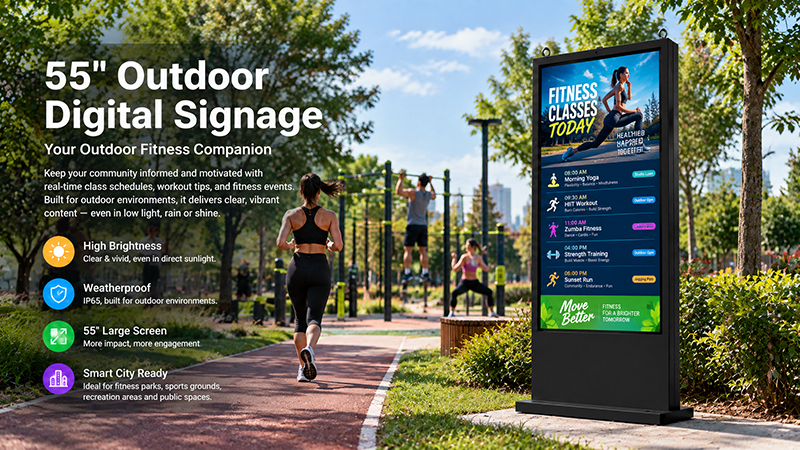
55 digital signage display1
3. IP65 Outdoor Advertising Displays: When Are They Appropriate?
IP65 is a widely used protection rating for outdoor digital signage. It offers dust-tight protection and resistance to water jets, making it suitable for many commercial installations.
Common applications include:
Outdoor shopping areas
Digital advertising displays near store entrances, under covered walkways, and beside commercial buildings can benefit from IP65 protection.
Gas stations
Outdoor advertising screens can show fuel promotions, convenience-store offers, and service information. IP65 may be suitable when the entire enclosure is designed for the installation environment.
Hotels and resorts
Outdoor displays can share welcome messages, event details, and promotional content near entrances and outdoor service areas.
Restaurant entrances
Restaurants can use outdoor advertising displays to feature menus, special offers, and promotional videos.
Public information displays
Outdoor information screens in suitable locations can use IP65 protection to help limit dust and water ingress.
Advantages of IP65
- Dust-tight enclosure protection.
- Resistance to water jets under specified test conditions.
- Suitable for many outdoor commercial applications.
- A practical balance between environmental protection and product design requirements.
- Potential limitations
IP65 does not indicate protection against the same powerful water-jet exposure tested under IP66.
For installations subject to particularly strong water jets, frequent pressure washing, or demanding cleaning conditions, buyers should consider whether IP66 or another protection level validated through specific testing would be more appropriate.
4. IP66 Outdoor Advertising Displays: When Are They Needed?
IP66 offers the same dust-tight protection as IP65, but it is tested to withstand more powerful water jets.
This rating may be worth considering for outdoor advertising displays installed where exposure to water is greater.
Typical applications include:
Fully exposed outdoor locations
Displays in open commercial areas may be more directly exposed to heavy rain and wind-driven water.
Industrial outdoor environments
Some industrial facilities require equipment enclosures capable of withstanding more demanding cleaning methods and water-jet conditions.
Public facilities
Outdoor displays in public spaces may require additional protection, depending on their location, cleaning procedures, and maintenance needs.
Locations requiring water-jet cleaning
Where installations are regularly cleaned with water jets, IP66 may be more suitable than IP65. However, the cleaning pressure, distance, and method should still be checked against the product’s test conditions.
Advantages of IP66
- Provides dust-tight protection.
- Tested for exposure to more powerful water jets.
- Offers greater resistance to the specified water-jet exposure than IP65.
- Suitable for some demanding outdoor and industrial environments.
- Potential Limitations
A higher IP rating does not automatically make a digital signage solution better overall.
IP66 does not guarantee protection against salt corrosion, chemical cleaning agents, extreme temperatures, or mechanical impact. Nor does it mean the display can necessarily be submerged in water.
Buyers should assess these requirements separately.
5. IP65 vs. IP66: Which Is Better for Outdoor Digital Signage?
Neither rating is universally superior for every project. The appropriate choice depends on the installation environment and the degree of water exposure.
| Selection factor | IP65 | IP66 |
|---|---|---|
| Dust protection | Dust-tight | Dust-tight |
| Rain exposure | Suitable when the complete product is properly designed | Suitable, with higher water-jet test resistance |
| Powerful water jets | Lower test level | Higher test level |
| Covered outdoor areas | Often sufficient | May be more than required |
| Open outdoor locations | Can be suitable | Worth considering for more demanding exposure |
| Pressure washing | Verify cleaning conditions | More suitable for some water-jet cleaning conditions |
| Product selection | Based on actual exposure | Based on more demanding water-jet requirements |
For many commercial outdoor advertising applications, IP65 offers a practical level of protection.
Consider IP66 when the display may be exposed to stronger water jets or more demanding cleaning procedures.
The key is to choose a protection rating that matches the actual environmental conditions, rather than assuming the highest rating is always required.
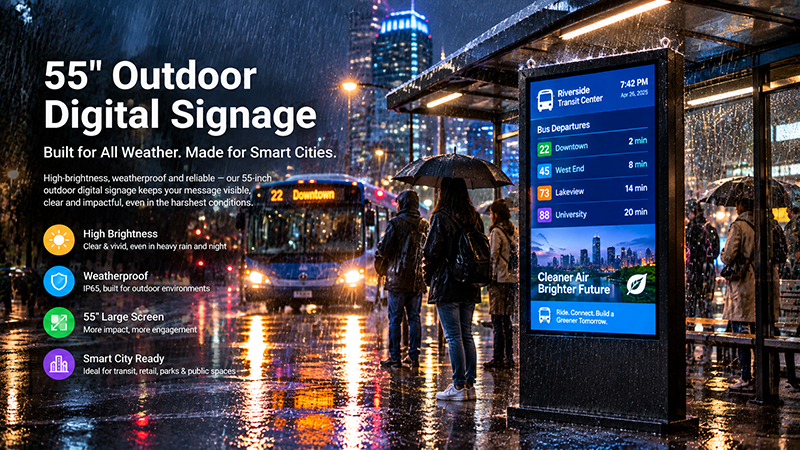
55 inch digital signage display
6. Does IP66 Mean the Display Is Waterproof?
This is a common misconception.
IP65 and IP66 are often referred to as waterproof ratings, but neither guarantees that a display is completely waterproof in all circumstances.
Both ratings specify protection against particular water-jet tests.
They do not automatically guarantee:
- Protection during continuous immersion underwater.
- Resistance to high-pressure, high-temperature cleaning.
- Protection against saltwater corrosion.
- Resistance to chemical cleaning products.
- Protection from condensation inside the enclosure.
- Resistance to every type of extreme weather.
For instance, a digital signage display installed near the coast may need additional corrosion protection, as airborne salt can gradually damage exposed metal parts and connections.
Likewise, a display in a high-humidity location requires suitable internal moisture and condensation management.
Always consult the product’s complete environmental specifications rather than relying on its IP rating alone.
7. Additional Factors to Consider When Selecting Outdoor Advertising Displays
IP protection is just one consideration when choosing an outdoor display. Other specifications also have a direct impact on performance and service life.
Brightness: 1500 Nits vs. 2500 Nits
Outdoor screens must be bright enough to remain visible in daylight.
1500 nits: May be appropriate for covered or partly shaded outdoor locations.
2500 nits: Offers greater brightness capacity for locations with more direct exposure.
The brightness required depends on factors such as sunlight direction, screen orientation, anti-glare treatment, and viewing distance.
A higher IP rating does not necessarily indicate greater brightness. Water resistance and screen brightness are separate specifications.
Impact Protection: IK Rating
Displays installed in public spaces may be subject to accidental impacts or vandalism.
An IK rating identifies how well an enclosure withstands mechanical impacts.
For example, IK10 denotes a defined level of impact resistance. This rating is independent of IP65 and IP66, so buyers should verify both ratings when physical protection is a priority.
Thermal Management
Outdoor displays must operate across changing temperatures. High-brightness LCD panels also produce heat while in use.
An appropriate thermal management design helps limit excessive internal temperatures and maintain reliable performance.
Review the operating temperature range, cooling system, and suitability of the display for the required daily operating schedule.
Installation Structure
Floor-standing and wall-mounted displays require different mechanical considerations.
For floor-standing units, assess the base, anchoring method, wind exposure, and cable routing. For wall-mounted displays, inspect the mounting structure and ensure cable connections are protected.
A high IP rating cannot make up for an unstable installation.
8. Portworld 55-Inch Outdoor Advertising Display
For commercial outdoor advertising projects, Portworld provides a 55-inch digital signage solution featuring high brightness and a protective enclosure.
Key specifications include:
- Screen Size: 55 inches
- Brightness: 1500–2500 nits, depending on configuration
- Ingress Protection: IP65
- Impact Protection: IK10
- Application: Outdoor advertising and public information
Operating Design: Designed to meet commercial extended-operation requirements
The available brightness levels of 1500–2500 nits enable buyers to assess configurations based on the installation environment.
Under specified test conditions, IP65 indicates dust-tight protection and resistance to water jets, while IK10 denotes a defined level of mechanical impact protection.
If a project specifically requires IP66, buyers should verify whether an IP66-certified configuration is available instead of assuming that the existing IP65 model satisfies this requirement.
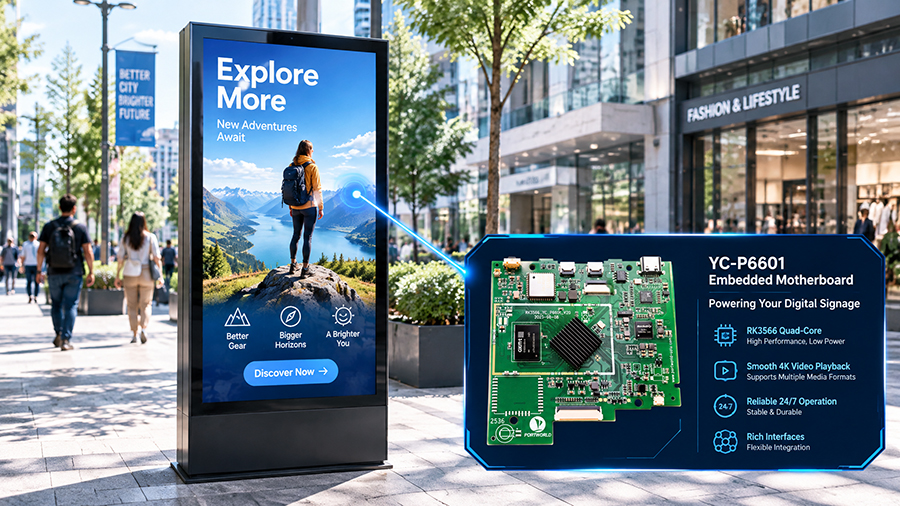
YC-P6601 digital signage display
Portworld also offers OEM/ODM services for commercial display projects, including:
- Display size and brightness configuration
- Embedded motherboard integration
- Customization of Android and Linux systems
- Enclosure and structural design
- Logo placement and exterior branding
- Supported connectivity options
- Application preinstallation
- Customized packaging and production
These services enable businesses and system integrators to develop display hardware tailored to their project requirements.