
Raspberry Pi 5 Costs Adding Up? Take a Look at PortPi 3A
Raspberry Pi is widely used for embedded development, industrial control, smart devices, and commercial applications. Its familiar development environment, rich community resources, and adaptable hardware ecosystem make it a practical choice for many projects.
Yet as projects scale, hardware expenses can become a more significant concern. Component costs, memory options, and long-term supply planning can all affect the total budget—particularly for businesses deploying devices in batches or preparing for mass production.
If your project does not rely on the Raspberry Pi ecosystem, consider exploring alternative single-board computers. Powered by the Rockchip RK3568 processor, PortPi 3A provides another platform, featuring flexible hardware configurations, support for multiple operating systems, and customization services from Portworld.
Why Are Developers Considering Alternatives to Raspberry Pi 5?
For individual developers and small-scale projects, the board’s upfront price may not be the only factor. In commercial and industrial applications, the total cost of ownership is often more significant.
Several factors can raise the overall cost of a Raspberry Pi-based project:
1. Hardware and memory costs
RAM and storage options influence the final hardware budget. If a project needs more memory or additional peripherals, costs can rise quickly.
2. Additional hardware requirements
A finished embedded product usually requires more than a development board. Displays, power supplies, enclosures, cables, communication modules, and other accessories can all increase the bill of materials.
3. Long-term supply planning
Reliable availability is essential for commercial products. A hardware platform must support both prototype development and repeat orders, as well as long-term production planning.
4. Limited customization for specialized products
A standard development board may include unnecessary interfaces or components while omitting features required for a particular application. This can result in additional hardware development and integration work.
These challenges make it worthwhile to assess platforms according to project requirements rather than selecting a board solely because it is widely recognized.
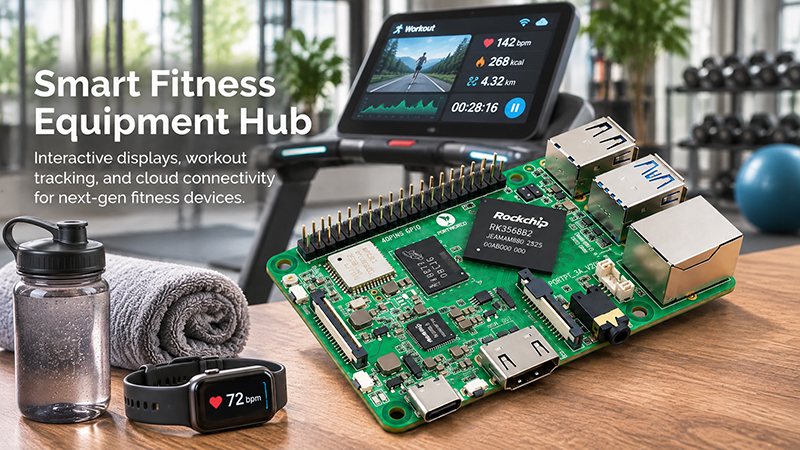
PortPi 3A Single board computer – Smart Fitness Equipment Hub
Meet PortPi 3A: A Configurable RK3568 Single-Board Computer
PortPi 3A is an independently developed single-board computer by Portworld, powered by the Rockchip RK3568 processor.
Designed for more than general-purpose development, PortPi 3A supports embedded applications that call for adaptable hardware configurations, a choice of operating systems, and engineering customization.
Key features include:
Rockchip RK3568 processor: A quad-core ARM Cortex-A55 platform for embedded computing and control tasks.
Multiple operating systems: Depending on the software configuration, the board supports Android, Ubuntu, Debian, and Buildroot.
Wireless connectivity: Wi-Fi and Bluetooth 5.2.
Wired networking: Gigabit Ethernet.
Display connectivity: HDMI output for compatible displays.
Peripheral expansion: USB connections for compatible external devices.
Flexible hardware configurations: RAM, storage, interfaces, and I/O options can be tailored to project requirements.
For developers creating a purpose-built embedded product, these capabilities offer greater flexibility than buying a standard board and adapting the application to fit it.
PortPi 3A vs. Raspberry Pi 5: What Should You Consider?
PortPi 3A and Raspberry Pi 5 are built on different hardware platforms and target somewhat different development needs. They should not be treated as direct, drop-in replacements.
The right choice depends on your application, software ecosystem, performance requirements, and production plans.
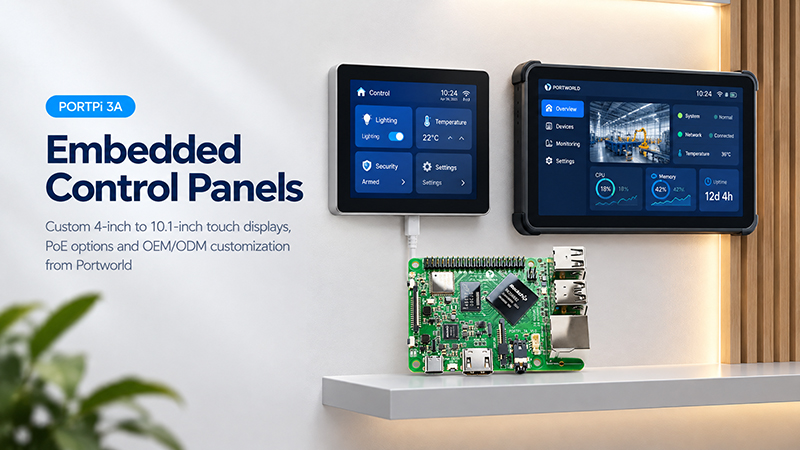
PortPi 3A single board computer
| Comparison | PortPi 3A | Raspberry Pi 5 |
|---|---|---|
| Processor | Rockchip RK3568 | Broadcom BCM2712 |
| CPU architecture | Quad-core Cortex-A55 | Quad-core Cortex-A76 |
| Operating system | Android, Ubuntu, Debian, Buildroot | Raspberry Pi OS and other compatible Linux systems |
| Wireless | Wi-Fi, Bluetooth 5.2 | Depends on model and configuration |
| Ethernet | Gigabit Ethernet | Gigabit Ethernet |
| Display | HDMI output | Dual micro-HDMI output |
| Hardware customization | Project-based RAM, storage, I/O, and interface customization | Primarily standard board configurations |
| Engineering support | Portworld OEM/ODM and hardware customization | Raspberry Pi ecosystem and third-party support |
Raspberry Pi 5 provides a more powerful CPU platform and a well-established developer ecosystem. PortPi 3A may be a better fit for projects that emphasize customized hardware, Android or embedded Linux integration, and engineering support from the manufacturer.
Before moving to a different platform, developers should verify software compatibility, peripheral drivers, display interfaces, and reliance on Raspberry Pi-specific accessories or libraries.
Where Can PortPi 3A Be Used?
PortPi 3A can function as the computing platform for a variety of embedded products. Its RK3568 architecture, flexible operating system options, and customizable hardware make it suitable for projects whose integration needs exceed what a standard development board can provide.
Smart Home Control Systems
PortPi 3A can be incorporated into smart home control terminals, gateway devices, and touchscreen interfaces. When paired with a compatible display and tailored software, it can enable centralized device management and smart home interactions.
Industrial HMI and Control Terminals
Industrial equipment often needs a compact computing platform that can connect displays, communication interfaces, and control peripherals. PortPi 3A can be configured for embedded HMI applications, with hardware and software adapted to the specific equipment.
Smart Coffee Machines and Appliances
Commercial appliances increasingly rely on embedded computing platforms to manage touchscreen displays, operating functions, connectivity, and user interactions.
PortPi 3A can be tailored for these applications through display integration, interface configuration, and application software customization.
Digital Signage and Commercial Displays
For compact advertising players and information terminals, PortPi 3A can serve as the computing platform for content playback, display control, and network connectivity. The target display resolution and output configuration should be verified against the chosen hardware design.
More Than a Development Board: Hardware Customization for Real Products
A key advantage of working with an embedded hardware manufacturer, rather than purchasing a standard development board, is the option to adapt the platform to the finished product.
Portworld offers hardware and software customization services for PortPi 3A projects, supporting customers as they progress from prototype development to production.
Depending on project needs, customization may include:
- RAM and storage configuration: Choose memory and storage options suited to the application.
- Interface and I/O customization: Configure available interfaces to connect displays, sensors, and external peripherals.
- Operating system adaptation: Tailor Android or Linux-based systems to the intended application.
- Software integration: Assist with application integration, system configuration, and startup behavior.
- Mechanical and structural design: Customize the enclosure and hardware arrangement for the finished device.
- OEM/ODM services: Support product branding, hardware development, and manufacturing needs.
Portworld also offers an optional 10.1-inch HDMI touchscreen monitor kit for projects requiring a display during development or product integration.
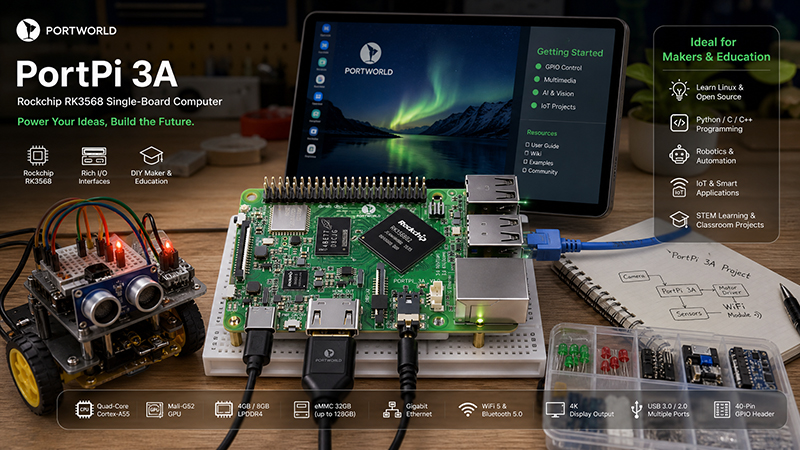
PortPi 3A DIY Education
A technical consideration is that HDMI transmits the display signal, while touchscreen input requires a separate compatible connection, such as USB, depending on the monitor configuration.
Look Beyond the Board’s Upfront Price
Selecting an embedded platform involves more than choosing the least expensive development board. A better assessment accounts for the project’s total cost.
This includes:
- Hardware and peripheral expenses
- Software porting and development effort
- Display and enclosure integration
- Long-term component availability
- Engineering assistance
- Production and maintenance needs
A platform with customization options and engineering support can help eliminate unnecessary components, streamline integration, and make production planning more predictable.
For companies developing commercial or industrial products, these considerations can be just as significant as processor performance.
Is PortPi 3A the Right Fit for Your Project?
If your application depends extensively on Raspberry Pi-specific software, accessories, or Raspberry Pi 5 performance, continuing with the Raspberry Pi 5 may be the most practical choice.
However, if you are building a dedicated embedded device and require flexible memory and storage options, Android or Linux compatibility, a customized interface, or OEM/ODM manufacturing services, PortPi 3A may be worth considering.
Built around the Rockchip RK3568, PortPi 3A offers developers and product manufacturers an alternative hardware platform, supported by Portworld’s embedded engineering and customization expertise.
Rather than redesigning your product to fit a standard development board, you can pursue a hardware configuration tailored to your application and manufacturing needs.
Seeking an embedded single-board computer for an upcoming project? Contact Portworld to discuss PortPi 3A configurations, customization options, and OEM/ODM services.

