What Protocols Should a Smart Meeting Room Control Panel Support?
Intelligent meeting rooms have become a fundamental component of contemporary office environments, facilitating user management of illumination, visual displays, video conferencing apparatus, climate control systems, window coverings, and room reservation platforms via a unified touchscreen control system.
An intelligent meeting room control interface functions as the primary user interaction point with networked equipment. To ensure dependable compatibility across diverse systems, it must accommodate multiple communication standards.
The optimal protocol selection is contingent upon the meeting room’s operational requirements and the nature of the devices requiring management.
1. Ethernet (RJ45) – Fundamental for Professional Meeting Rooms
Ethernet represents a critical communication interface for institutional meeting room control interfaces.
It delivers:
- Dependable network connectivity
- High-capacity data transfer
- Compatibility with organizational infrastructure
- Integration with facility management systems
Ethernet is predominantly utilized for:
- Video conferencing platforms
- Room reservation management systems
- Electronic information displays
- Centralized administrative systems
In professional deployments, Power over Ethernet (PoE) proves exceptionally advantageous, as it permits the control interface to obtain both electrical power and data transmission through a singular network conduit.
Advantages of PoE:
- Streamlined deployment procedures
- Minimized cable infrastructure
- Simplified upkeep requirements
- Refined wall-integrated installation aesthetics
2. WiFi – Adaptable Wireless Connectivity
WiFi enables smart meeting room panels to establish connections with wireless devices and cloud-based platforms.
Primary use cases encompass:
- Integration of mobile devices
- Cloud-based meeting administration
- Internet of Things device interaction
- Remote system maintenance
WiFi proves advantageous in contemporary office environments where adaptable installation and wireless connectivity solutions are essential.
YC-LE156
15.6″ Meeting Room Display Panels
3. Bluetooth / BLE – Proximity-Based Device Linking
Bluetooth Low Energy (BLE) serves as the standard protocol for establishing connections between adjacent devices.
A smart meeting room control panel equipped with Bluetooth functionality can integrate with:
- Wireless audio systems
- Sensory equipment
- Mobile devices
- Intelligent accessories
Key benefits:
- Minimal energy requirements
- Simplified device pairing procedures
- Rapid device identification
BLE demonstrates particular utility for identity verification, spatial proximity assessment, and peripheral device management.
4. RS485 and Modbus – Building Automation and HVAC Integration
Numerous commercial facilities implement hardwired industrial communication standards including RS485 and Modbus protocols.
A meeting room control panel incorporating RS485 compatibility can interface directly with:
- Heating, ventilation, and air conditioning controllers
- Air conditioning units
- Temperature regulation systems
- Power consumption monitoring devices
- Building management infrastructure
Key advantages:
- Extended-range data transmission
- Dependable communication performance
- Robust interference resistance
Illustration:
Smart Meeting Room Panel → RS485 Modbus → HVAC Controller
Operators may regulate:
- Room temperature
- Ventilation speed
- Air conditioning settings
directly via the interactive display interface.
2. WiFi – Adaptable Wireless Connectivity
WiFi enables smart meeting room panels to establish connections with wireless devices and cloud-based platforms.
Primary use cases encompass:
- Integration of mobile devices
- Cloud-based meeting administration
- Internet of Things device interaction
- Remote system maintenance
WiFi proves advantageous in contemporary office environments where adaptable installation and wireless connectivity solutions are essential.
YC-LE156
15.6″ Meeting Room Display Panels
3. Bluetooth / BLE – Proximity-Based Device Linking
Bluetooth Low Energy (BLE) serves as the standard protocol for establishing connections between adjacent devices.
A smart meeting room control panel equipped with Bluetooth functionality can integrate with:
- Wireless audio systems
- Sensory equipment
- Mobile devices
- Intelligent accessories
Key benefits:
- Minimal energy requirements
- Simplified device pairing procedures
- Rapid device identification
BLE demonstrates particular utility for identity verification, spatial proximity assessment, and peripheral device management.
4. RS485 and Modbus – Building Automation and HVAC Integration
Numerous commercial facilities implement hardwired industrial communication standards including RS485 and Modbus protocols.
A meeting room control panel incorporating RS485 compatibility can interface directly with:
- Heating, ventilation, and air conditioning controllers
- Air conditioning units
- Temperature regulation systems
- Power consumption monitoring devices
- Building management infrastructure
Key advantages:
- Extended-range data transmission
- Dependable communication performance
- Robust interference resistance
Illustration:
Smart Meeting Room Panel → RS485 Modbus → HVAC Controller
Operators may regulate:
- Room temperature
- Ventilation speed
- Air conditioning settings
directly via the interactive display interface.
7. Matter – Future Smart Building Compatibility
Matter represents an emerging connectivity standard for smart homes and buildings, engineered to enhance interoperability across disparate ecosystems.
Matter integration enables meeting room systems to connect with:
- Intelligent lighting solutions
- Sensory devices
- Internet of Things products
Advantages:
- Enhanced cross-platform interoperability
- Streamlined device integration processes
- Forward-compatible smart building infrastructure
8. HDMI, USB, and Other AV Interfaces
In sophisticated meeting room environments, the control panel requires the capability to interface with audio and video systems.
Primary interfaces encompass:
- HDMI
- USB
- USB-C
Key Functions:
- Monitor and display management
- Video capture device connectivity
- Video conferencing system integration
- Multimedia content distribution
Suggested Protocol Integration Framework for Intelligent Conference Room Display Systems
Various use cases necessitate distinct communication functionalities.
| Application | Recommended Protocols |
|---|---|
| Small meeting room | WiFi + Bluetooth + Ethernet |
| Corporate meeting room | Ethernet + PoE + MQTT |
| Smart office building | Ethernet + RS485 Modbus + MQTT |
| HVAC integrated room | RS485 + Modbus + Ethernet |
| IoT-based meeting room | WiFi + Zigbee + Matter |
| Large commercial projects | Ethernet + PoE + Multiple Protocol Gateway |
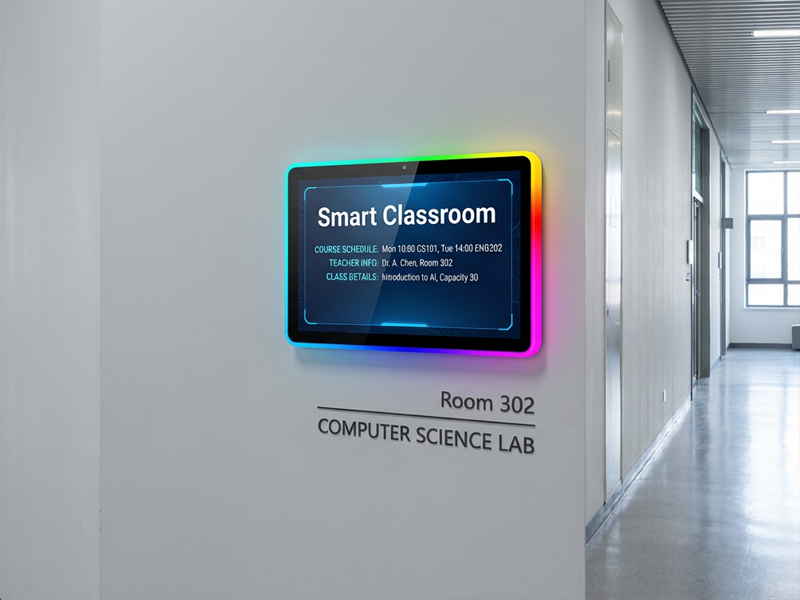
YC-LE156
15.6″ Meeting Room Display Panels
Portworld Smart Meeting Room Control Panel Solutions
Portworld specializes in the development of adaptable intelligent touch-activated control panels engineered for:
- Automation of meeting spaces
- Intelligent workplace infrastructure
- Facility and infrastructure oversight
- Commercial Internet of Things deployments
Portworld intelligent control panels are compatible with multiple computational architectures, encompassing ESP32 processors and Rockchip-based Android/Linux platforms, incorporating optional connectivity features including:
- Wireless networking
- Bluetooth technology
- Ethernet connections
- Power over Ethernet
- RS485 serial communication
- Proprietary communication interfaces
As an illustration, Rockchip-based intelligent panels such as the YC-SM10P deliver substantial computational performance, interactive touchscreen functionality, Ethernet-based network connectivity, and comprehensive customization capabilities suitable for intelligent workplace environments.