
RK3572 vs RK3588: Choosing the Right Rockchip AI Processor for Embedded Applications
As artificial intelligence transitions from cloud environments to edge devices, embedded products are becoming progressively more intelligent. Smart displays, industrial computers, robotic systems, and IoT terminals now necessitate more than just basic processing capabilities. They require AI acceleration, robust multimedia performance, adaptable connectivity, and dependable long-term operation.
Among Rockchip’s AI-capable processors, the RK3572 and RK3588 have garnered considerable interest from developers and system integrators. Both platforms are tailored for AIoT and edge computing applications, yet they cater to distinct performance requirements.
Selecting the appropriate processor involves more than merely choosing the most powerful chip. The optimal solution is contingent upon the application scenario, AI workload, display specifications, power constraints, and system complexity.
This article delves into the fundamental differences between the RK3572 and RK3588, assisting developers in selecting the most suitable AI processor for their embedded applications.
RK3572 and RK3588: Distinct Positioning for Varied Applications
Both the RK3572 and RK3588 are part of Rockchip’s AI computing platform family, but they address different market needs.
The RK3572 is positioned as a high-performance AIoT processor for edge computing devices, smart terminals, and intelligent embedded applications. It emphasizes achieving a balance among computing capability, AI performance, power efficiency, and system cost.
Conversely, the RK3588 is designed as a flagship-level edge computing processor for applications that demand higher CPU/GPU performance, advanced multimedia processing, and more intensive AI workloads.
For embedded product designers, the selection can be encapsulated as follows:
RK3572 → A well-rounded AIoT solution that offers remarkable performance and efficiency.
RK3588 → A robust edge computing platform tailored for high-demand applications.
CPU Performance: Balancing Efficiency and Maximum Computing Power.
The CPU architecture represents one of the most significant distinctions between the RK3572 and RK3588.
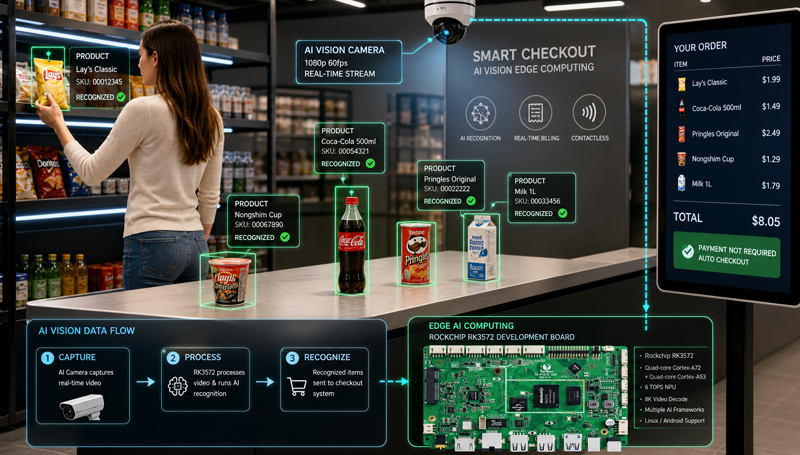
rk3572-motherboard
RK3572
The RK3572 features:
- 2 × Cortex-A73 high-performance cores
- 6 × Cortex-A53 efficiency cores
This octa-core configuration delivers adequate computing power for:
- Smart displays
- Industrial HMIs
- IoT gateways
- Embedded control systems
- AI-enabled terminals
RK3588
The RK3588 employs a more advanced architecture:
- 4 × Cortex-A76 high-performance cores
- 4 × Cortex-A55 efficiency cores
This architecture offers considerably enhanced general computing performance, making it ideal for:
- Advanced robotics
- Edge AI servers
- High-performance industrial computers
- Complex multimedia systems
Which option should you select?
For applications primarily centered on:
- Touch interaction
- Display control
- Lightweight AI inference
- IoT communication
The RK3572 is generally adequate.
For applications that necessitate:
- Multiple AI workloads operating concurrently
- Intensive Linux applications
- Complex algorithms
- Extensive data processing
The RK3588 offers greater performance capacity.
AI Processing Capability: Intelligent Solutions at the Edge
The acceleration of AI is increasingly becoming a critical consideration when choosing embedded processors.
Both the RK3572 and RK3588 are equipped with dedicated AI acceleration engines, enabling devices to conduct AI inference locally rather than depending entirely on cloud computing.
The RK3572 features an NPU that supports various AI precision formats, including:
- INT4
- INT8
- INT16
- FP4
- FP8
- FP16
- BF16
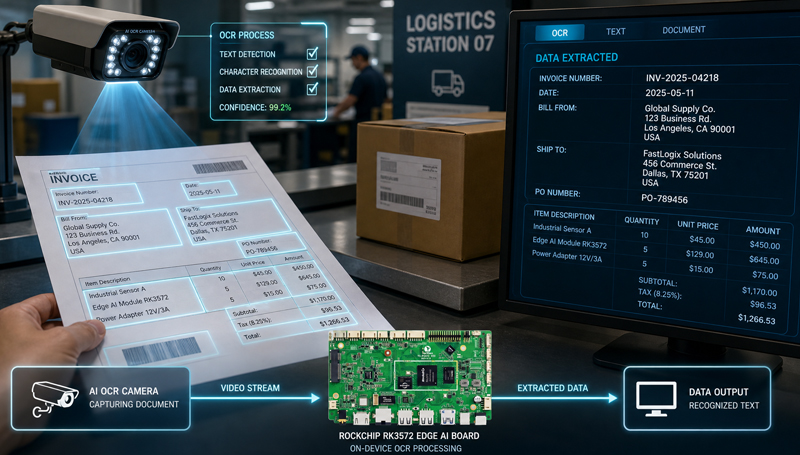
rk3572-motherboard
It also accommodates AI frameworks such as TensorFlow, PyTorch, MXNet, and Caffe.
The RK3588 offers a more advanced AI processing platform with a 6 TOPS NPU, making it ideal for more sophisticated AI vision and edge computing applications.
Ideal for:
- Single-camera AI recognition
- Smart kiosks
- AI digital signage
- Industrial monitoring terminals
- Smart home devices
RK3588 AI Applications
Better for:
- Multi-camera analytics
- Advanced machine vision
- AI robots
- Edge AI servers
- Complex computer vision systems
Multimedia Capability: Smart Display and Vision Applications
Modern embedded devices increasingly rely on sophisticated multimedia processing.
RK3572 Multimedia Features
RK3572 offers advanced video decoding capabilities, including:
- H.265
- VP9
- AV1
- AVS2
and supports up to:
8K@30fps video decoding
This renders RK3572 appropriate for:
- Digital signage
- Interactive displays
- Smart panels
- Commercial terminals
RK3588 Multimedia Advantage
RK3588 boasts a more robust multimedia engine, supporting:
- 8K video decoding
- Higher-performance video encoding
- Advanced multi-display capability
It is more suitable for:
- Professional multimedia terminals
- Video processing systems
- High-end smart displays
- Multi-screen applications
Camera and AI Vision Processing
In the realm of AI vision applications, the processing capabilities of cameras are of utmost importance.
The RK3572 features a 12-megapixel ISP that incorporates hardware acceleration technologies such as:
- HDR
- 3A processing
- Noise reduction
- Image enhancement
- Lens distortion correction
Additionally, it supports MIPI CSI camera input, facilitating the integration of camera modules for AI vision applications.
The RK3572 is well-suited for:
- Smart cameras
- Retail analytics
- Industrial inspection
- Interactive terminals
On the other hand, the RK3588 offers a more robust vision platform for:
- Multi-camera systems
- Autonomous robots
- Advanced surveillance
- Machine vision platforms
Connectivity and Expansion: Developing Comprehensive Embedded Systems
An effective embedded product necessitates not only computational capabilities but also adaptable hardware expansion.
The RK3572 includes interfaces such as:
- HDMI 2.1
- MIPI display
- USB 3.0
- PCIe
- Gigabit Ethernet
- Wi-Fi 6
- Bluetooth 5.0
- CAN
These attributes render it appropriate for:
- Industrial control terminals
- Smart displays
- IoT gateways
- Intelligent equipment
The RK3588 provides even more extensive high-speed expansion options, making it ideal for more intricate systems that demand:
- Multiple displays
- High-speed storage
- Advanced networking
- Larger AI workloads
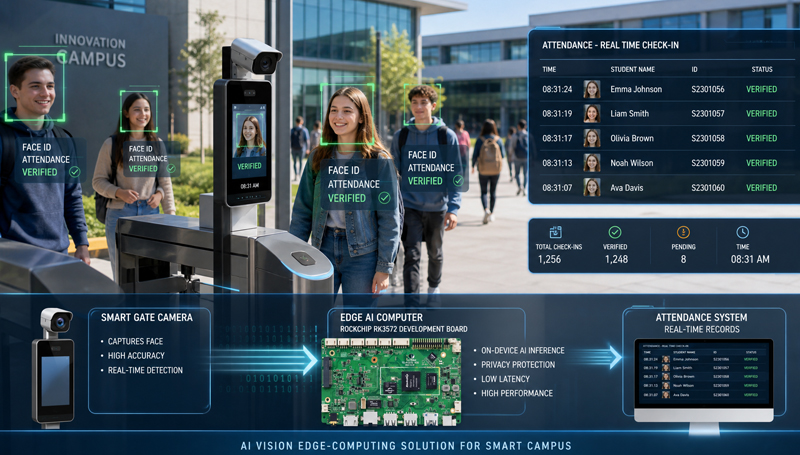
rk3572 motherboard
RK3572 vs RK3588 Application Comparison
| Application | Recommended Processor |
|---|---|
| AI Digital Signage | RK3572 / RK3588 |
| Smart Touch Display | RK3572 |
| Industrial HMI | RK3572 |
| Smart Healthcare Terminal | RK3572 |
| AI Camera | RK3572 |
| Multi-camera Vision System | RK3588 |
| Advanced Robotics | RK3588 |
| Edge AI Server | RK3588 |
| High-performance Industrial Computer | RK3588 |
When deciding between RK3572 and RK3588, consider your product requirements.
Opt for RK3572 if your project necessitates:
A balance between performance and power efficiency
- Edge AI capabilities
- Integration with smart displays
- Applications for industrial terminals
- Economical AIoT solutions
On the other hand, select RK3588 if your project demands:
- Superior computing performance
- Handling of complex AI algorithms
- Processing from multiple cameras
- High-quality multimedia features
- Sophisticated edge computing applications
Creating Advanced Embedded Solutions with Portworld
For developers of embedded products, choosing the appropriate processor is merely the initial step. To achieve successful commercial products, a comprehensive solution is essential, which includes:
- Embedded hardware design
- Touch display integration
- Industrial enclosure design
- Software optimization
- Application customization
With expertise in industrial touch displays, smart terminals, and embedded computing solutions, Portworld assists clients in transforming AI processor platforms like RK3572 and RK3588 into fully functional intelligent products.
Whether you are working on an AI digital signage system, an industrial HMI, a healthcare terminal, or a robotics device, selecting the right Rockchip platform can significantly enhance product development and deployment.

