
Both featuring 8 cores and 6 TOPS, why is the RK3576 a tier weaker than the RK3588?
PART/1
Over the past two years, Rockchip processors have seen continuously rising popularity in industrial, AI, and robotics fields. Among them, the RK3576 and RK3588 SoCs have attracted significant attention. Both are equipped with an 8-core CPU and a 6 TOPS NPU. With the RK3576 being more affordable and having lower power consumption, it naturally raises the question: Can it replace the RK3588? What is the actual performance gap between them? This article will provide a detailed analysis of their core differences through measured data, offering reliable reference for chip selection.
RK3588 VS RK3576
PART/2
RK3588 VS RK3576
CPU: Same Architecture, Core Generation Determines Performance Level
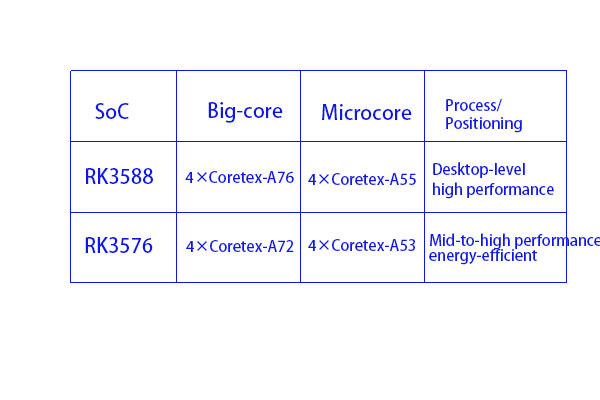
Both the RK3576 and RK3588 employ an 8-core big.LITTLE design, but their core generations are completely different. The RK3588 uses a combination of 4 Cortex-A76 big cores and 4 Cortex-A55 little cores, aiming for “desktop-class high performance.” In contrast, the RK3576 pairs 4 Cortex-A72 big cores with 4 Cortex-A53 little cores, positioning itself as “mid-to-high performance, leaning towards efficiency.”
The Cortex-A76 represents a generational leap over the A72, with significant enhancements in key areas like instruction prediction, execution width, and cache architecture. According to measured data, the RK3588’s comprehensive CPU performance is 40%–66% higher than the RK3576’s, with the single-core performance gap potentially exceeding 50%–70% (depending on the task type). This indicates that the RK3588 handles multi-concurrent tasks faster and holds a more pronounced advantage when running complex applications like digital twins or 3D rendering. Moreover, the heavier the load, the greater the RK3588’s lead—truly, “same 8 cores, but each core is more powerful.”
PART/3
NPU: Same Parameters, Efficiency is Key
Many people glancing at spec sheets might mistakenly think the NPU performance of the RK3576 and RK3588 is identical. However, during actual deployment, it becomes clear that being able to run a model doesn’t equate to running it fast.
The RK3588’s NPU advantage lies primarily in “efficiency.” It offers better compatibility with mainstream models like YOLO and ResNet, stronger multi-threaded inference throughput capability, and greater stability when running multiple models in parallel. Additionally, its QINT8/INT4 quantization toolchain is more mature, leading to faster inference speeds and, in some scenarios, higher operator utilization.
Based on AI Benchmark test results, for single-stream inference of the same model, the RK3588 is 15%–30% faster than the RK3576. In multi-stream concurrent throughput, the RK3588 outperforms by 30%–50%. Thus, the RK3588 is better suited for high-frequency inference scenarios like intelligent security and industrial inspection, while the RK3576 fits medium inference tasks like classification and OCR. Although both NPUs are rated at 6 TOPS, the “value” differs; the RK3588 can utilize its computational power more fully.
PART/4
RK3588 VS RK3576
GPU and Video Processing Capability
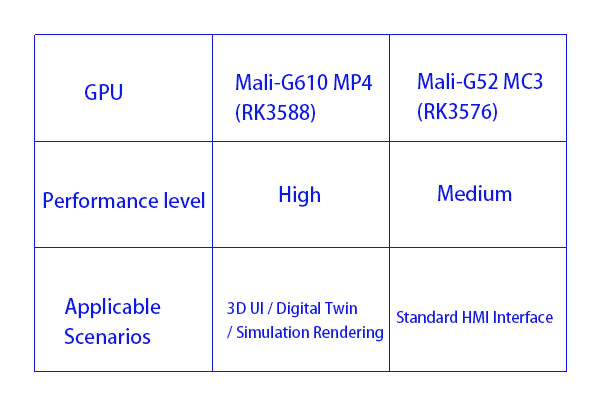
There is a noticeable gap in graphics processing capability between the RK3588 and RK3576. The RK3588 is equipped with a Mali-G610 MP4 GPU, rated as “high-performance,” capable of easily handling applications like 3D UI and digital twins. The RK3576, however, uses a Mali-G52 MC3 GPU, rated as “mid-range,” suitable only for standard HMI interfaces. Tests show the RK3588’s comprehensive GPU performance is 60%–120% higher than the RK3576’s.
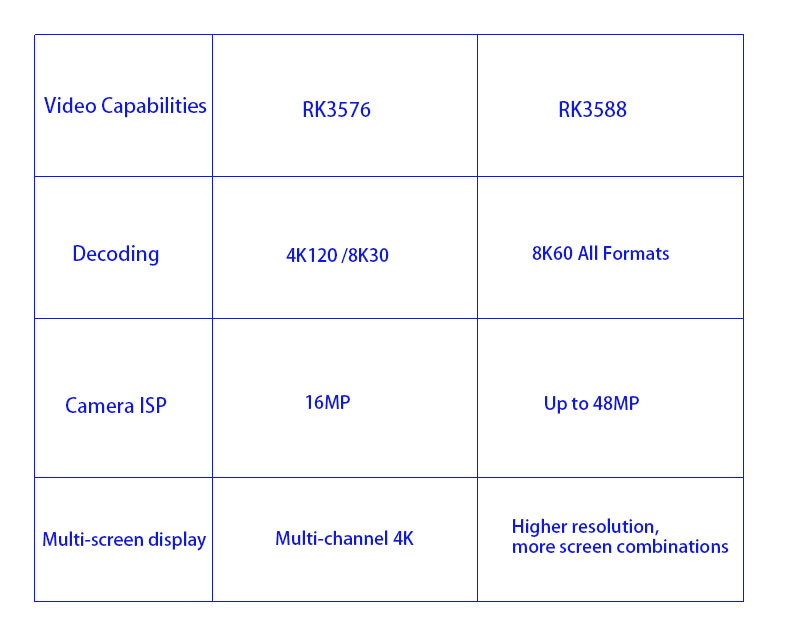
The gap in video processing is even more significant. Regarding decoding capability, the RK3576 supports 4K120/8K30, while the RK3588 supports 8K60 and a more comprehensive range of formats. For ISP (camera image processing), the RK3588 supports up to 48MP, which is 2-3 times that of the RK3576 (16MP). In multi-display support, the RK3588 allows for higher-resolution combinations and more screens. Simply put, for tasks involving multi-camera capture, 8K large-screen splicing, etc., the RK3588 offers a higher performance ceiling and is less prone to bottlenecks.
RK3588 VS RK3576
PART/5
Memory and Interfaces: System Throughput Determines Expansion Potential
A chip’s performance isn’t just about strength in individual areas; more importantly, it’s about the overall system’s carrying capacity. The RK3588 excels in system throughput. Its memory bandwidth is 64-bit compared to the RK3576’s 32-bit, representing a 30%–70% improvement. Furthermore, the RK3588 supports high-speed interfaces like PCIe 3.0, USB3.x, and multiple MIPI-CSI lanes, better meeting demands for multi-camera input and high-throughput data processing.
For industrial scenarios, this means the RK3588 holds clear advantages in the number of connectable cameras, real-time storage write speeds, and high-frame-rate AI inference. The RK3588 is more like an extensible flagship platform capable of handling complex tasks, while the RK3576 is better suited for cost-sensitive deployment projects.
PART/6
Power Consumption and Cost: The RK3576’s Core Competitiveness
When selecting a chip, one shouldn’t focus solely on performance strength but also consider whether the chip fits the specific application scenario. The RK3576’s main advantages are low power consumption and low cost. Its typical power consumption is 20%–40% lower than the RK3588’s, making it very suitable for gateway devices requiring large-scale deployment. Simultaneously, the RK3576’s BOM cost is lower, effectively reducing overall unit cost, which is ideal for control and edge nodes.
Therefore, the RK3576 is better suited for large-scale AI collection edge nodes, industrial HMI and human-machine interfaces, mid-range AI computing boxes, and products prioritizing high cost-performance and stable supply. The RK3588, on the other hand, is more fitting for AI clusters, visual inspection, robotics, cloud-edge collaboration, lightweight large models, multi-camera and multi-task concurrency, as well as scenarios like digital twins and 3D visualization.
PART/7
Different Positioning, Each Has Its Merits
In summary, the RK3588 is a flagship performance platform, while the RK3576 is a mid-to-high-end efficiency platform. Although both NPUs boast 6 TOPS, the RK3588 is stronger in full-pipeline performance, making it more suitable for scenarios with higher demands on AI and video processing. The RK3576 offers higher cost-performance, making it better for large-scale deployment and medium visual computing tasks. Simply put, the RK3588 pursues performance limits, while the RK3576 seeks a “cost-power consumption” balance.
| Item | RK3576 | RK3588 | Advantage of RK3588 |
|---|---|---|---|
| CPU Overall Performance | Mid‑High | High | +35~65% |
| Single‑Core Performance | Moderate | Strong | +50~80% |
| NPU Concurrent Efficiency | Good | Stronger | +30~50% |
| GPU Graphics | Moderate | Strong | +60~120% |
| Video Codec | 4K/8K30 | 8K60+, more formats | +40~80% |
| ISP Capability | 16MP | 48MP | ~2–3× |
| Memory Bandwidth | 32‑bit | 64‑bit | +30~70% |
| High‑Speed Interfaces | Standard | More abundant | 1.5–3× |
| Power Efficiency | Lower | Medium‑High | RK3576 more efficient |
| Target Applications | Mid‑range AI / batch devices | High‑performance AI / multi‑channel vision | Computer vision & embedded |

